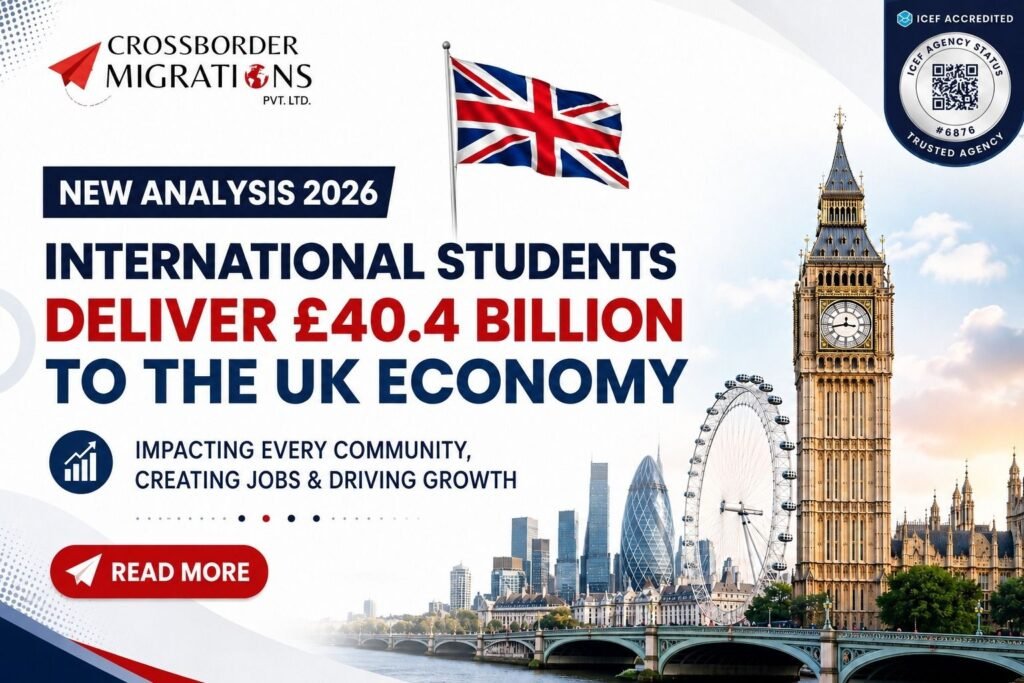
New 2026 analysis shows that the value of international education extends far beyond university tuition fees.
International education is often discussed through the lens of university rankings, tuition fees, visa rules and graduate opportunities. A new economic analysis adds another important dimension: the contribution international students make to the wider UK economy and to communities across the country.
Research produced by London Economics for the Higher Education Policy Institute (HEPI) and Kaplan International Pathways estimates that international students who began higher education courses in the UK in 2024/25 will generate a net economic benefit of approximately £40.4 billion over the course of their studies.
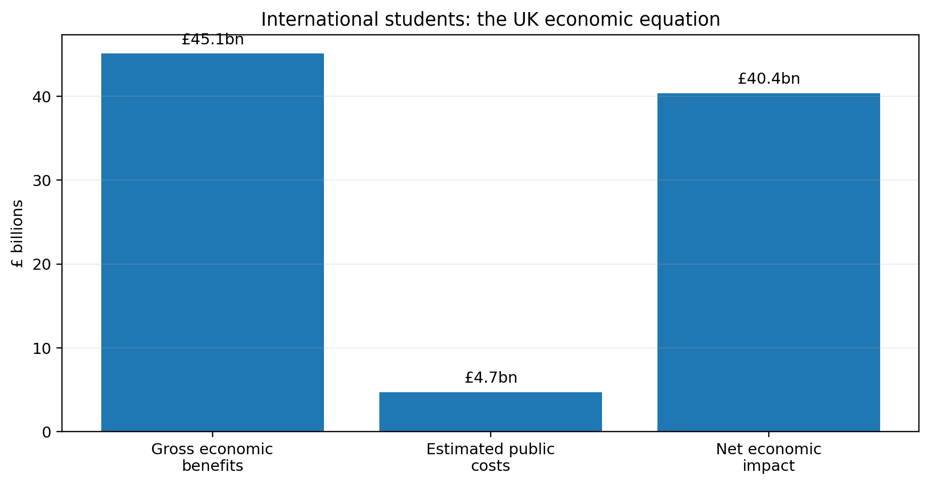
The analysis covers around 404,500 international students entering UK higher education in 2024/25. It estimates £45.1 billion in economic benefits against approximately £4.7 billion in public-sector costs, producing the £40.4 billion net figure.
An important qualification is that £40.4 billion is not an annual contribution. It represents the estimated net economic impact associated with the 2024/25 cohort across the duration of their studies.
Every 10 international students represent about £1 million in net value
The report estimates an average net contribution of roughly £100,000 per international student. Put another way, every 10 international students are associated with approximately £1 million in net economic benefit for the UK over the duration of their studies.
The economic effect is broader than university income. International students spend on accommodation, food, transport, retail, leisure and other services. Universities also use fee income to employ staff and purchase goods and services, while friends and relatives visiting students create additional spending.
Where does the economic value come from?
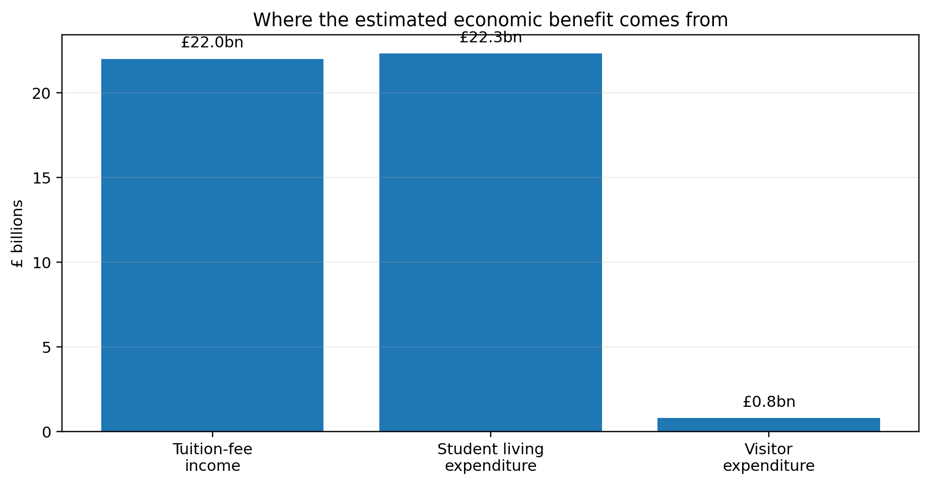
The analysis separates the gross economic benefit into three broad sources. Approximately £22.0 billion is associated with international tuition-fee income, £22.3 billion with students’ wider expenditure, and about £0.8 billion with expenditure by visiting friends and family.
The impact reaches communities across the UK
One of the strongest findings in the research is the geographical spread of the benefit. The study used students’ term-time addresses to estimate economic effects at parliamentary-constituency level rather than treating international education as a benefit concentrated only in major university cities.
Across parliamentary constituencies, the average net contribution is estimated at around £62 million, equivalent to approximately £580 for every resident. The figures vary significantly between regions, reflecting differences in international student numbers, course mix, study duration and local economic conditions.
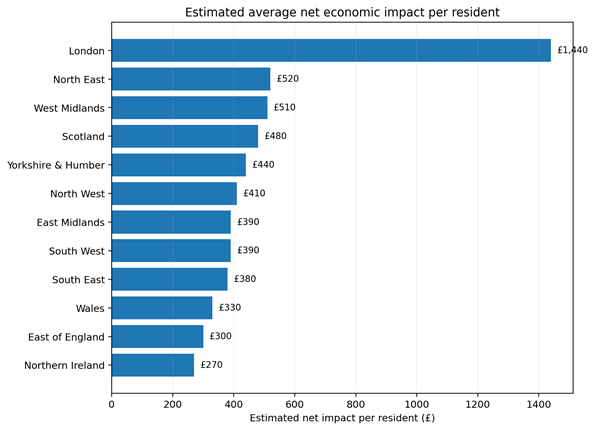
Figure 3. Estimated average net economic impact per resident by UK nation/region. Source: London Economics for HEPI and Kaplan International Pathways, 2026.
London leads, but the story is national
London has the highest estimated average net impact per resident at around £1,440. However, the analysis also records substantial contributions across the North East, West Midlands, Scotland, Yorkshire and the Humber, North West and other regions.
This matters because it challenges the idea that international students are primarily an issue for London or a small group of elite universities. International education supports economic activity across a much wider network of university towns, cities and communities.
The UK is also seeing a decline from its recent peak
While international students remain economically significant, the report identifies a clear warning sign: the number of international first-year higher education students has fallen from its post-pandemic peak.
International first-year enrolments reached approximately 459,200 in 2022/23. By 2024/25, the comparable figure was around 404,500 — a decline of approximately 12%, or about 54,500 students.
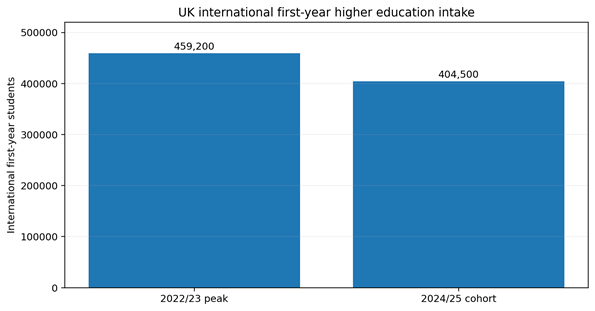
Figure 4. International first-year higher education entrants in the UK: 2022/23 peak versus 2024/25. Source: London Economics/HEPI analysis, 2026.
The researchers estimate that if the 2022/23 level had been maintained in 2024/25, the net economic impact would have been around £2.9 billion higher. The difference is also associated with approximately 23,300 fewer full-time equivalent jobs supported by international students.
Pakistan remains an important market for UK higher education
For students and education professionals in Pakistan, the UK remains a particularly important destination. The 2024/25 analysis places Pakistan among the leading source countries for new international entrants, with approximately 34,400 students entering UK higher education during the year.
The figure represents a substantial increase compared with 2021/22. This continued demand illustrates the strength of the UK-Pakistan education relationship even as the wider international recruitment environment becomes more competitive.
What are international students studying?
The 2024/25 international first-year cohort is strongly weighted towards postgraduate education. Approximately 65% were enrolled on taught postgraduate programmes, 5% on postgraduate research programmes, and 27% on first-degree programmes, with the remainder undertaking other undergraduate qualifications.
Approximately 96% of the cohort studied full-time. The report also estimates different average economic impacts by level of study, reflecting differences in course duration and spending patterns.
Why the findings matter for prospective students
The economic impact figures should not be interpreted as a promise of individual financial success. A student’s outcome still depends on the quality and relevance of the chosen programme, total costs, career prospects, location and personal circumstances.
However, the research provides valuable context. International students participate in a much larger ecosystem that includes universities, accommodation providers, retailers, hospitality businesses, transport services, professional services and other local employers.
| International education is not simply a university transaction — it is part of a wider economic ecosystem. |
What should Pakistani students consider before choosing the UK?
- Choose the course before the destination: The programme should fit the student’s academic background and long-term career objective.
- Assess the complete cost: Tuition fees, accommodation, transport, living expenses and other mandatory costs should be considered together.
- Look beyond London: Major UK cities outside London can offer strong universities and different cost-of-living profiles.
- Check current immigration requirements: UK visa and post-study rules can change, so students should rely on current official guidance.
- Think about long-term value: A good study-abroad decision balances academic quality, employability, affordability and personal goals.
The UK’s international education market is becoming more competitive
The report notes that the traditional group of leading destinations — the United States, United Kingdom, Australia and Canada — now competes with a much wider set of destinations. Students have more choices across Europe and other emerging education hubs.
For the UK, maintaining its position will therefore depend not only on university reputation but also on affordability, the student experience, immigration policy, graduate opportunities and the country’s broader international appeal.
What the latest figures tell us
| Indicator | 2026 analysis |
| 2024/25 international first-year entrants | Approximately 404,500 |
| Estimated gross economic benefits | £45.1 billion |
| Estimated public-sector costs | £4.7 billion |
| Estimated net economic impact | £40.4 billion |
| Average net contribution per student | Approximately £100,000 |
| Estimated FTE jobs supported | Approximately 287,300 |
| Average impact per parliamentary constituency | Approximately £62 million |
| Average impact per UK resident | Approximately £580 |
| Estimated loss versus maintaining 2022/23 intake | Approximately £2.9 billion |
Conclusion
The latest analysis provides a clear economic case for the continued importance of international education to the UK. The 2024/25 international student cohort is estimated to generate £40.4 billion in net economic value over the duration of its studies and support around 287,300 full-time equivalent jobs.
At the same time, the fall in new international student numbers shows that the UK’s position cannot be taken for granted. Global competition is increasing, and students have more destinations from which to choose.
For prospective students from Pakistan, the key lesson is not that the UK is automatically the right destination. Rather, the data confirms that the UK remains a major international education market with globally recognised institutions and a broad economic ecosystem around international students. The right decision should be based on the student’s academic profile, career plans, budget and long-term objectives.
About Crossborder Migrations
CROSSBORDER MIGRATIONS (PVT) LIMITED supports students and professionals with international education and migration planning. Our approach is centred on informed decision-making, helping applicants understand study destinations, programmes, admission requirements and the wider pathway before making an application.
Sources & methodology note
This article is an original editorial analysis prepared for CrossBorder Migrations Pvt. Limited. It is based primarily on the July 2026 report produced by London Economics for the Higher Education Policy Institute (HEPI) and Kaplan International Pathways. The article does not reproduce the original report’s graphics; the charts in this document are newly designed visualisations using reported figures.
Primary research: HEPI – The benefits and costs of international higher education students to the UK economy (2026)
Full report: London Economics – Full 2026 report
Related source: ICEF Monitor – New analysis measures the impact of international education for each UK community and resident