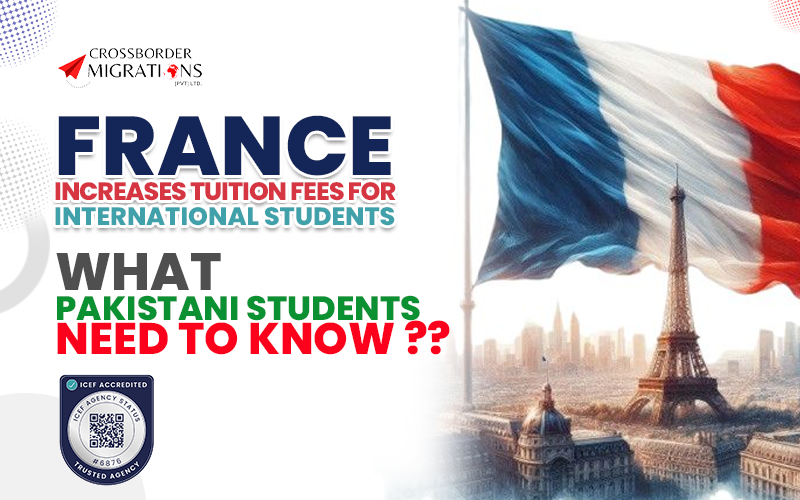
France has announced a significant change to its higher education policy that will affect international students planning to study at public universities. Starting from the 2026/27 academic year, most students coming from outside the European Union will be required to pay higher tuition fees.
For many years, France has been known for offering highly subsidized education with minimal tuition costs, making it one of the most attractive destinations for students from countries like Pakistan. This new policy signals a shift toward a more structured fee system for international applicants.
NEW TUITION STRUCTURE
Under the framework introduced by Philippe Baptiste, tuition fees for non-EU students will now be standardized at €2,895 annually for bachelor’s programmes and €3,941 for master’s programmes.
Previously, most public universities charged only nominal administrative fees, often less than €300 per year, regardless of nationality. This made France exceptionally accessible to students from developing countries. With the new structure, while education remains subsidized, students will now be contributing a more substantial share toward the cost of their studies.
WHEN WILL THE NEW FEES APPLY?
The revised tuition fees will come into effect from September 2026 and will apply exclusively to newly enrolled students. Those who are already studying in France will continue to benefit from the existing low-fee structure.
However, the timing of this announcement—during an ongoing admission cycle—has created a level of uncertainty among prospective applicants. Many students who had already planned their finances based on previous costs may now need to reconsider their options or adjust their budgets accordingly.
EXEMPTIONS AND SCHOLARSHIPS
Although the new policy applies broadly, the French government has indicated that a limited number of students will still be eligible for exemptions. These will primarily be reserved for scholarship holders and individuals facing genuine financial hardship.
It is important to note that the number of exemptions will be restricted, with an estimated cap of around 10% of the student population. Furthermore, a significant portion of financial aid will be directed toward students pursuing studies in priority sectors such as artificial intelligence, healthcare, environmental sciences, biotechnology, and digital technologies. This means that while opportunities for support still exist, they will be more competitive and strategically allocated.
WHY IS FRANCE INCREASING FEES?
The decision to increase tuition fees is part of a broader national strategy aimed at strengthening France’s higher education system and addressing long-term economic needs. The government is seeking to attract international talent in key sectors that are essential for future growth and innovation.
At the same time, public universities in France have been facing financial pressures due to rising operational costs, including salaries and energy expenses. By introducing higher fees for non-EU students, the government aims to provide institutions with additional financial support while maintaining overall affordability compared to global standards.
HOW FRANCE COMPARES GLOBALLY
Even with the revised tuition structure, France remains a relatively affordable destination when compared to countries such as the United Kingdom, the United States, Canada, and Australia, where international tuition fees are significantly higher and often exceed €15,000 per year.
However, the new policy may reduce France’s competitive advantage in Europe, particularly when compared to Germany, where public universities generally charge only minimal semester or administrative fees. As a result, cost-sensitive students may begin to explore alternative destinations more actively.
INTERNATIONAL STUDENT TRENDS: FRANCE VS GERMANY
France and Germany continue to attract a large number of international students each year, with both countries showing steady growth. However, their positioning differs significantly in terms of affordability and regional appeal.
| Factors | France | Germany |
| Total International Students | ~443,500 | ~420,000 |
| Growth Trend | Moderate increase | Steady growth |
| Tuition Fees (Public Universities) | €2,895–€3,941/year (non-EU) | Mostly free (€100–€400/semester fees) |
| Regional Strength | Strong in Africa | Growing in South Asia & Africa |
| Cost Competitiveness | Medium | High |
| Language of Instruction | French + English | Mostly English (especially Master’s) |
PAKISTAN-FOCUSED ANALYSIS
For Pakistani students, this development introduces an important shift in study abroad planning. France has traditionally been considered a highly affordable European option, but the increase in tuition fees means that financial considerations will now play a much larger role.
Students will need to demonstrate stronger financial capacity, not only for tuition but also for living expenses and visa requirements. This may limit access for some middle-income families and increase reliance on scholarships or external funding.
At the same time, competition for financial aid is expected to intensify, particularly in high-demand fields. Pakistani students may also begin to consider alternative destinations such as Germany and other European countries that offer lower tuition costs.
Ultimately, this change makes it essential for students to take a more strategic approach—carefully evaluating the total cost of education, potential career outcomes, and long-term return on investment before making a decision.
INDUSTRY AND STUDENT REACTIONS
The policy has received mixed reactions within France’s academic community. Many universities and student organizations have expressed concerns that higher fees could discourage talented students from lower-income countries and reduce the diversity of international enrolments.
There is also skepticism about whether the additional revenue generated will be sufficient to resolve the deeper financial challenges faced by public universities. As a result, discussions are ongoing regarding the possibility of expanding exemptions, introducing flexible payment options, and ensuring fair access to education for international students.
FINAL THOUGHTS
France continues to offer world-class education, strong research opportunities, and valuable international exposure. However, with the introduction of higher tuition fees, affordability will become a more significant factor in decision-making for international students.
For those considering France, early planning, financial preparation, and professional guidance will be key to navigating this transition successfully.
START YOUR STUDY ABROAD JOURNEY WITH A TRUSTED PARTNER
At Crossborder Migrations PVT Limited, we provide expert guidance to students planning to study abroad, ensuring every decision is aligned with your academic goals, financial capacity, and long-term career plans.
We are proud to be an internationally recognized and accredited consultancy, holding the following credentials:
- ICEF Accredited Trusted Agency – IAS Status (#6876)
- PIER – Australia QEAC (#12772) – Qualified Education Agent Counsellor
- ICEF IATC (#2359) – Internationally Accredited Training Certificate
Our team includes certified country specialists with globally recognized credentials:
- USA Counsellor – ICEF (USCG#725)
- Canada Counsellor – ICEF (CCG#2445)
- New Zealand Counsellor – ICEF (NZCG#128)
- Ireland Counsellor – ICEF (ICG#189)
- Malta Counsellor – ICEF (MCG#12)
- France Counsellor – ICEF (FASFG#00039)
In addition, we are accredited by the British Council with:
- UK Agent Counsellor Training Certificate (UKACTC#20523)
We also maintain active memberships with leading global education bodies:
- Member of ICEF
- Member of the British Council
- Member of NAFSA: Association of International Educators
These accreditations reflect our commitment to transparency, ethical practices, and delivering reliable guidance to students across Pakistan.
BOOK YOUR FREE CONSULTATION TODAY
If you are planning to study abroad in 2026 or beyond and want clear, expert guidance after recent policy changes, now is the time to act.
At Crossborder Migrations PVT Limited, we offer end-to-end study abroad and immigration services designed to maximize your success at every stage:
We assist students with career-focused counselling and country selection, helping you choose the best destination based on your budget, profile, and future goals. Our team handles university admissions and application processing for top institutions across the UK, Australia, Canada, Germany, Ireland, USA, and more.
We provide expert scholarship guidance to help reduce your financial burden, along with complete student visa documentation and filing support to ensure a strong and compliant application. To further improve approval chances, we conduct professional mock interview sessions based on real embassy scenarios.
In addition, we offer English language preparation support (IELTS/PTE) through our academy, along with pre-departure guidance to help you transition smoothly into your new academic environment.
TAKE THE NEXT STEP TOWARD YOUR FUTURE
Get in touch with Crossborder Migrations PVT Limited today to:
- Explore the most affordable study abroad destinations
- Secure admission in top-ranked international universities
- Build a strong student visa application with expert guidance
- Increase your chances of visa approval and long-term success
Your global education journey starts here—connect with our certified experts today.